
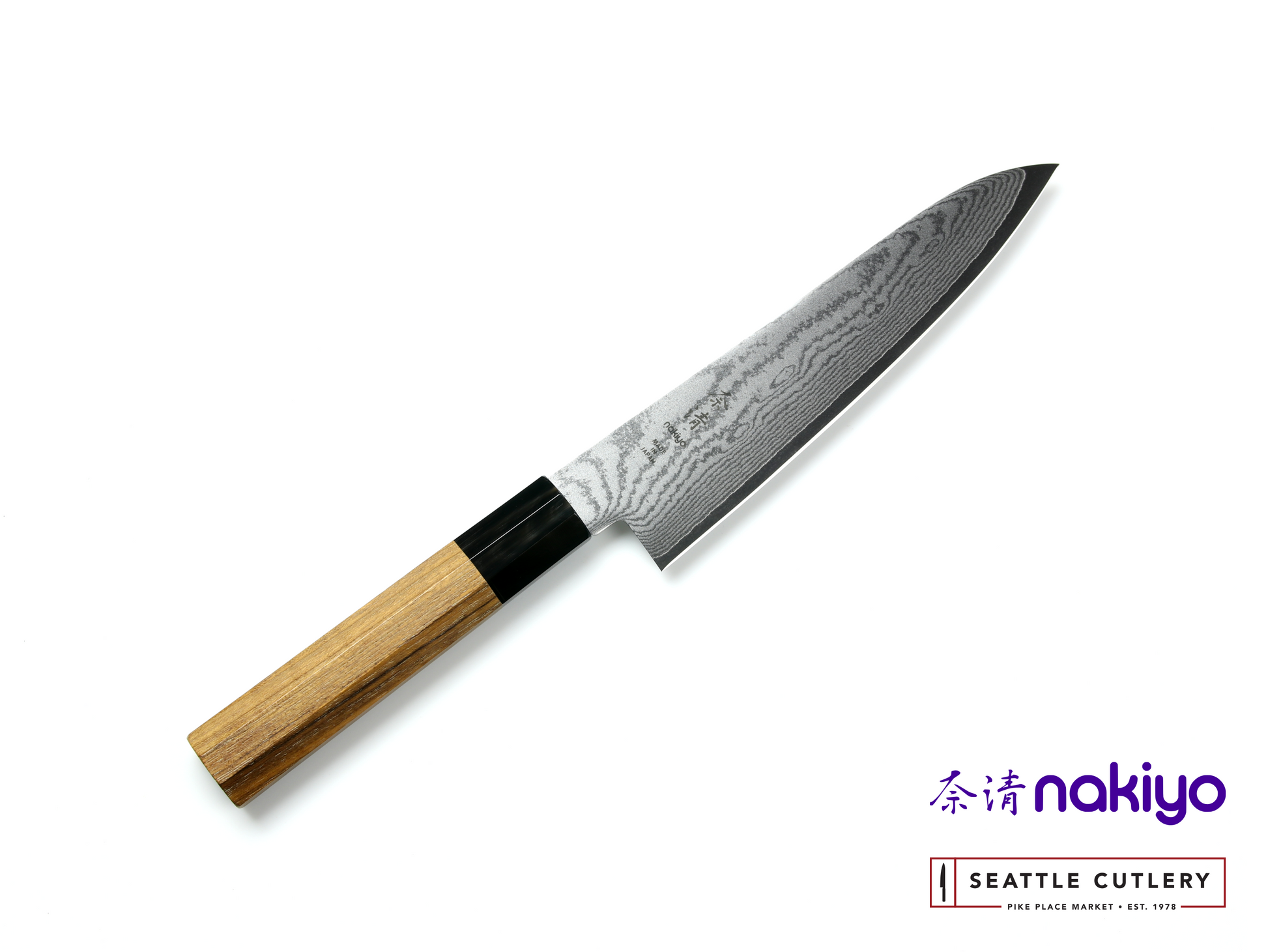
Nakiyo Teak Damascus 7" Gyuto/Chef
Nakiyo Teak Damascus 7" Gyuto/Chef
Low stock
Couldn't load pickup availability
Share
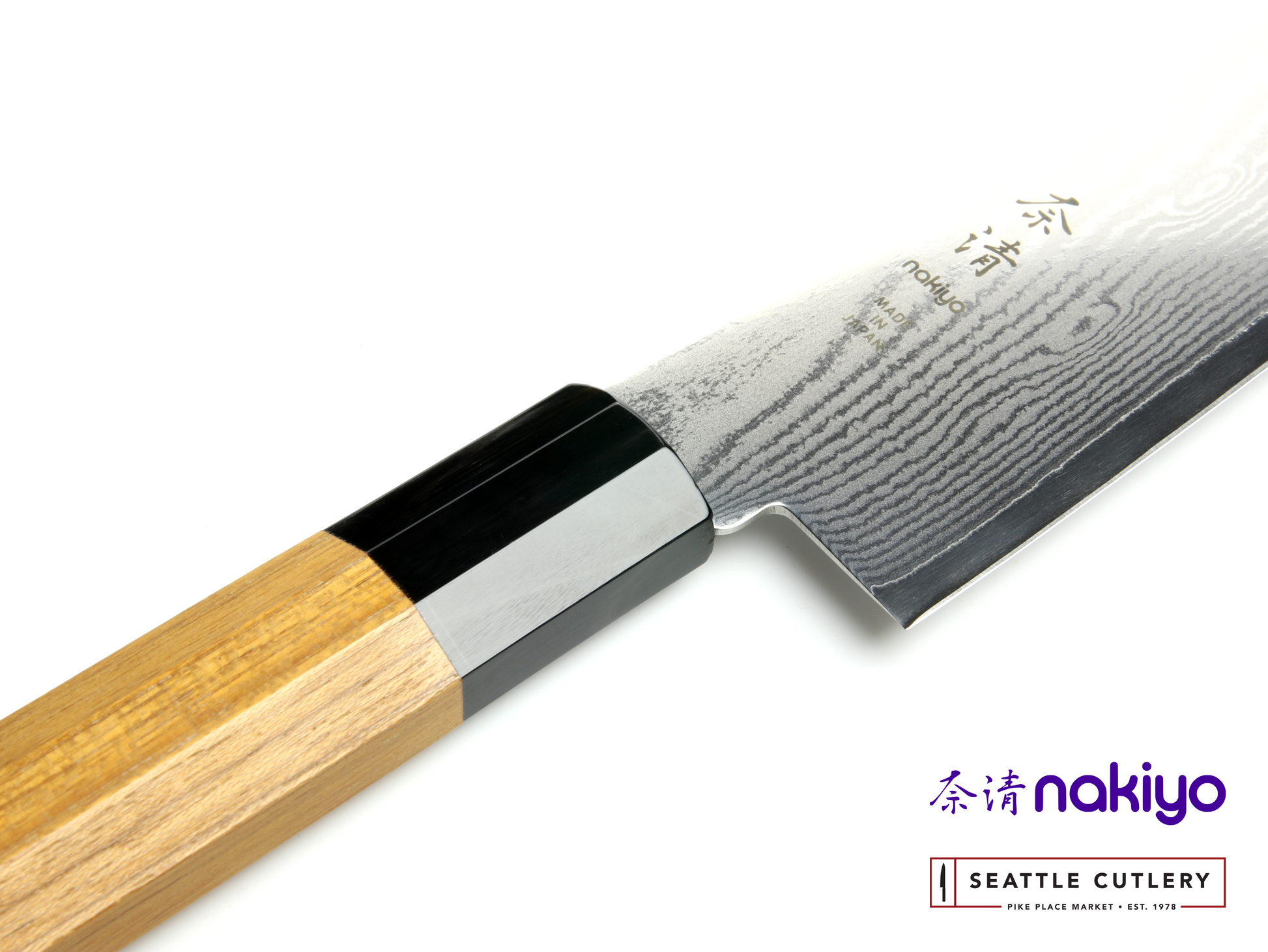
The Nakiyo Teak Damascus series is made for us by Tojiro in Tsubame, Japan. Featuring the same traditional construction and Damascus steel blade as the Tojiro Shippu series, this line features handles of teak wood and water buffalo horn with an octagonal profile suitable for both right- and left-handed users.
Specifications
Please note that measurements may vary slightly from piece to piece and from the manufacturer's published specifications. If you have precise requirements, please contact us before placing your order.Blade length: 180 mm (7.1")
Overall length: 320 mm (12.6")
Weight: 120 g (4.2 oz.)
Blade steel: 63-layer Damascus with VG10 cobalt alloy core
Handle material: Solid teak wood with buffalo horn ferrule
Handle shape: Octagonal
Edge: Double bevel
Function
Function
Gyūtō (牛刀), meaning "beef knife," is the Japanese term for a French-pattern chef’s knife. Also known as the yo-boucho (洋包丁), “Western chef’s knife,” the gyuto was developed in Japan after the Meiji Restoration of 1868. This blade shape was originally designed to process large cuts of beef but is now the most popular general-purpose knife in the Western kitchen. In addition to slicing meat, the gyuto is also particularly suited for chopping produce near the heel and for making finer cuts with the narrow tip.
Blade
Blade
Nakiyo Damascus blades are forged from 63-layer (all larger knives) or 37-layer (paring, peeling, and petty knives) Damascus steel, which is made by repeatedly folding and forge welding two stainless steels with different carbon contents. The resulting material bears the elegant, wavelike pattern produced by its many fine layers—a testament to its strength, flexibility, and durability. This Damascus envelops a core of harder VG-10 cobalt alloy steel, a high-carbon stainless steel developed in Japan. Hardened to HRC 62, it accommodates a long-lasting, razor-sharp edge.
Damascus steel was first developed in India over 2,000 years ago and quickly established a reputation not only for its beauty, but also as one of the greatest metallurgical innovations in history. Swords forged in Persia and sold in the Syrian city of Damascus inspired legends of their ability to slice through a gun barrel or part a hair falling across the blade. Although the ancient technique was lost to history around 1900, modern metallurgists have succeeded in reproducing the effect with state-of-the-art alloys to bring performance to the next level.
Handle
Handle
The lightweight handle is crafted from strong and durable teak (Tectona grandis) wood and provides a secure grip without upsetting the knife’s balance. The wood, among the most water-resistant species in the world, is secured and accented by a ferrule (collar) of black water buffalo horn. Its octagonal profile guarantees a firm hold and is suitable for both right- and left-handed users.
Care & Maintenance
Care & Maintenance
Wash your knife by hand with warm water, soap, and a soft sponge or dish towel. Avoid prolonged exposure to heat or moisture. Remember—there's no such thing as a dishwasher-safe knife!
To prevent edge chips, avoid impacts with hard surfaces. Don't chop bones, shells, or frozen food, and cut only on a wood or bamboo cutting board. Don't leave your knife where the edge might come in contact with something hard, such as in a sink or a drawer with other knives.
Store your knife so that the edge is protected from abrasion and impact. We recommend a magnetic stand, but you can also use a knife block with horizontal slots. If you must keep it in a drawer, use an edge protector. See our storage options here.
Sharpening
Sharpening
Sharpen on a whetstone at an angle of 15° per side and finish at a grit of at least 1000, but preferably 3000 or higher. Pull-through and electric sharpeners should be avoided for Japanese knives.
Alternatively, you can have your knives sharpened professionally. Seattle Cutlery offers a state-of-the-art, mail-in sharpening service for our own customers, but other services may be available to you locally.
Honing steels are not necessary to maintain Japanese knives. You can optionally touch up the edge with a high-grit sharpening stone or a ceramic sharpening rod.
Warranty
Warranty
All Nakiyo, Tojiro, Sabatier, and SeaCut products sold by Seattle Cutlery are covered by our lifetime warranty against defects in materials and workmanship. If you follow our care and maintenance advice and your knife ever fails during honest use, we will gladly repair or replace it. Our warranty does not cover regular wear and tear or damage due to misuse, but we may still be able to help in some cases.
Returns
Returns
Any item in original, unused condition may be returned within 30 days for any reason. Shipping charges are non-refundable. Read our full refund policy here.
Very nice knife.
I purchased this knife on a recent trip to Seattle. I had been looking for a good, quality knife and I'm so glad I stumbled upon this one. It's lightweight yet firm, with a perfect balance when I hold it. This knife was the perfect addition to my kitchen and I'm about to gift one to my mom.
